The problem
- Comments are not uniformly handled within a project.
- Rules for them are arbitrary and not statically enforced.
- Comments consume precious code review time.
- Comments are treated as a second-class citizen compared to code.
Arguments from both sides of the debate:
| No comments | Comments |
|---|---|
| Code should be self-explanatory. | Prose can express a wider variety of concepts. |
| Maintenance burden | Onboarding can be easier. |
| Redundancy | Present limitations can be documented. |
| Compiler can check code | Domain knowledge is shared. |
The solution: Comments-Toolkit
Arguing about no-comments vs. comments is like arguing about tabs vs. spaces. We solved that debate with tooling years ago: we use it in editors, configure projects with it, and we barely talk about it anymore. Instead of wasting time on conventions, we relied on tooling.
Proposal: Comments-Toolkit handles comments more rigorously, in a way similar to code, with checks in:
- CI pipelines
- Local hooks
- Editor tooling
How it works
- A parser for C-like comments (more languages in the future).
- Developers stamp their comments with additional data:
- Lines of code below the comment that the comment references
- Dependencies on other comments
- (More fields in the future, if there are interesting ideas)

What the checker looks for
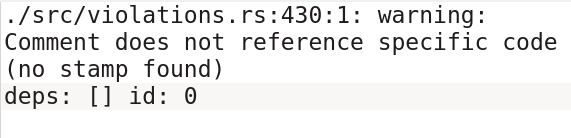
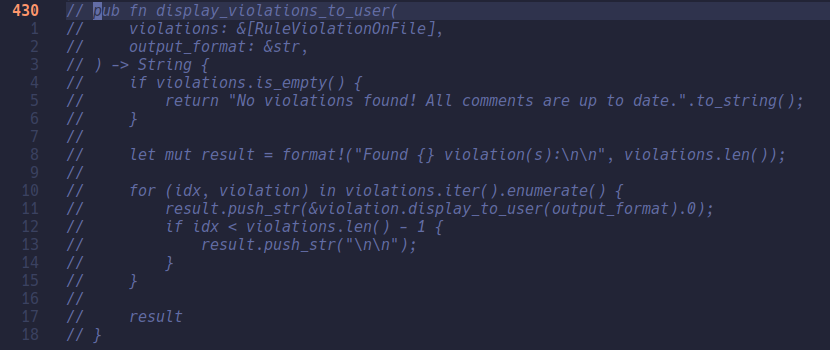
- Unstamped comment (does not reference specific code).
- Comment hash not generated yet (stamped by the developer but not yet by the tool).
- A comment that others depend on has been changed or deleted.
- Dependency on a comment that does not exist.
- Dependency on a comment that has been changed (so we can review that we are still OK with it).
Violations are emitted for each of those checks in the desired format (editor / GitHub pipelines). Each violation has a level: Warning, Error or Note, configurable per check with a config file.
Examples
Not updating the comment
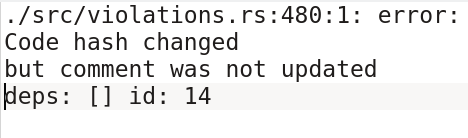
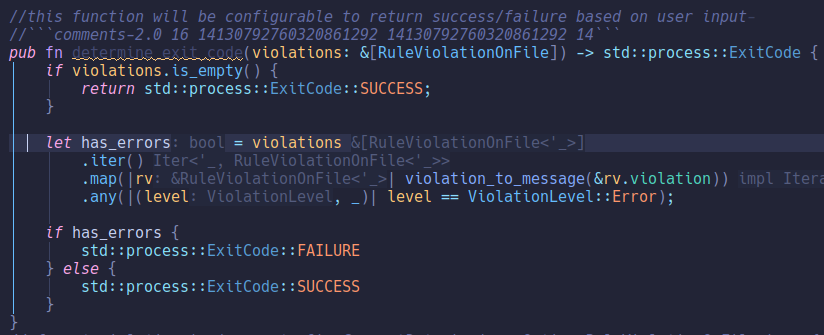
Comment that does not reference code (unstamped)
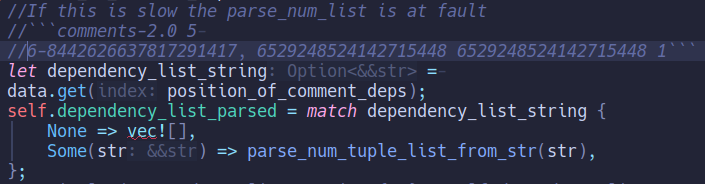
Comment has a dependency

Ways to use it
- Pre-commit git hook (implemented)
- GitHub Actions (implemented)
- LSP in editor (TODO)
Design goals
- No external services
- Reasonably fast
- Frictionless DX (TODO)
- Incremental adoption (TODO)
Roadmap to V1
- Support all popular programming languages.
- Property-based testing to catch weird bugs sooner.
- More extensive beta testing on small/individual projects.
Future ideas
- Support all programming languages.
- LSP support to use it smoothly inside editors.
- Cross-project/repo comment references (useful for workarounds for bugs in upstream projects).
- Tree-sitter-based parsing instead of a hand-written parser.
- Grammar-aware stamping of comments (something similar to tree-sitter selectors).